 |
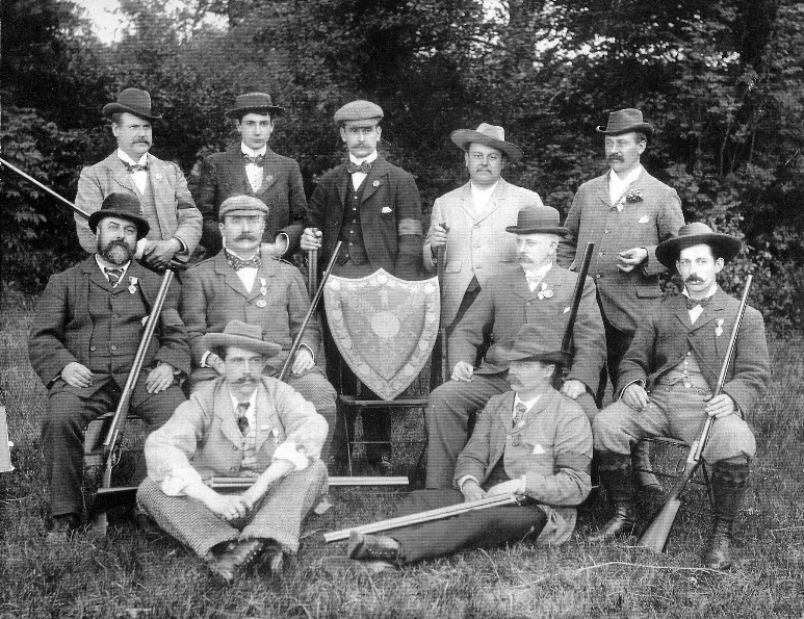 Click image to en-large The winners of the International Shield at the I.B.S.A Championship Meeting - Wembley Park May 1896
|
 |
The Inanimate Bird Shooting Association (I.B.S.A.) and the Leeson
Link The sport of live pigeon trap shooting is first recorded toward the end of the eighteenth century but its popularity varied, suffering much from swings in fashion. Many English gun makers recognized the potential to increase sales if their guns were used successfully within the sport. However, almost from the outset, the shooting of captive or trapped live pigeons was met with opposition. In the mid nineteenth century a group of aristocratic shooters revived the sport again with the creation of a club at Horsey Wood House in London (an area of what is now Finsbury Park). However, live pigeon shooting was expensive and limited to a relatively small group of the population. Towards the end of the nineteenth century social pressure, on humanitarian grounds, both from the public and shooting groups was being exerted in an effort to ban the practice all together. Some sceptics would claim that the creation of this new sport of clay shooting was merely a mechanism created by makers of guns and cartridges alike to sell more of their products. Truth is that the growing middle cases within the Victorian era, who exhibited a more humane attitude, in combination with gun and ammunition makers, created a natural progression towards inanimate target shooting. This new sport would need also to be less expensive than its live pigeon shooting counterpart. Around 1880 an American, George Ligowsky, obtained a patent for his disk throwing machine suitable to throw a clay type target. Prior to clay targets, some clubs had experimented with glass spheres which contained feathers, which upon being broken by shot, emulated a real bird. The problem experienced with the glass sphere, and to a large extent with the clay target was the predictability of the flight of the projectile, something that could not be assumed with the live pigeon. For this reason some of the more established clubs, like the Hurlingham club, who had experimented with clay targets, continued to shoot their preferred live quarry until around 1905. The Notting Hill club defiantly continued with live pigeon shooting until just prior to the First World War in 1914. The Victorians would have to apply there considerable ingenuity to making a launching system that provided more realistic and variable flight. However, inanimate target shooting was gaining popularity and appealed to a much large group of shooting enthusiasts, not only because of its relative cheapness but also clubs could be setup more easily close to towns and cities. The increasing wealth of the up and coming middle classes, combined with the ability to purchase cheaper “factory” made guns rather than bespoke London guns plus the improving transport network enabling easier access to shooting clubs brought the concept of target shooting for enjoyment within the reaches of a much larger group. In 1892 the Inanimate Bird Shooting Association (I.B.S.A.) was founded, its founding members largely coming from gun and ammunition makers. It held its first championship at Wimbledon Park in London on 29th July 1893. The competition involved shooting over 10 inanimate targets. There were 44 entries in the 10-bird competition and the winner, Mr. Frank Izzard (Mr. Izzard was a 1896 team member - see photo) won with a score of 9. The first international trap shooting match was held at Wembley Park in 1895. Teams of guns, each 11 strong, represented England, Ireland and Scotland. The competition required each team member to shoot at 30 targets. England was victorious. The team picture (follow link), shows the 11 man winning team for the IBSA International Shield, held at Wembley Park, London in May 1896. Archie St. John Leeson, aged around 18 years old, appears second from left on the back row in the boater hat. In 1900 “trap shooting” made its first appearance in the Olympic Games, and again in 1908. In 1903 the IBSA changed its name to the Clay Bird Shooting Association. Live pigeon shooting from traps was finally banned in 1921 under the Captive Birds Shooting Prohibition (Act) 1921 and consequently clay pigeon shooting became even more popular. |
